
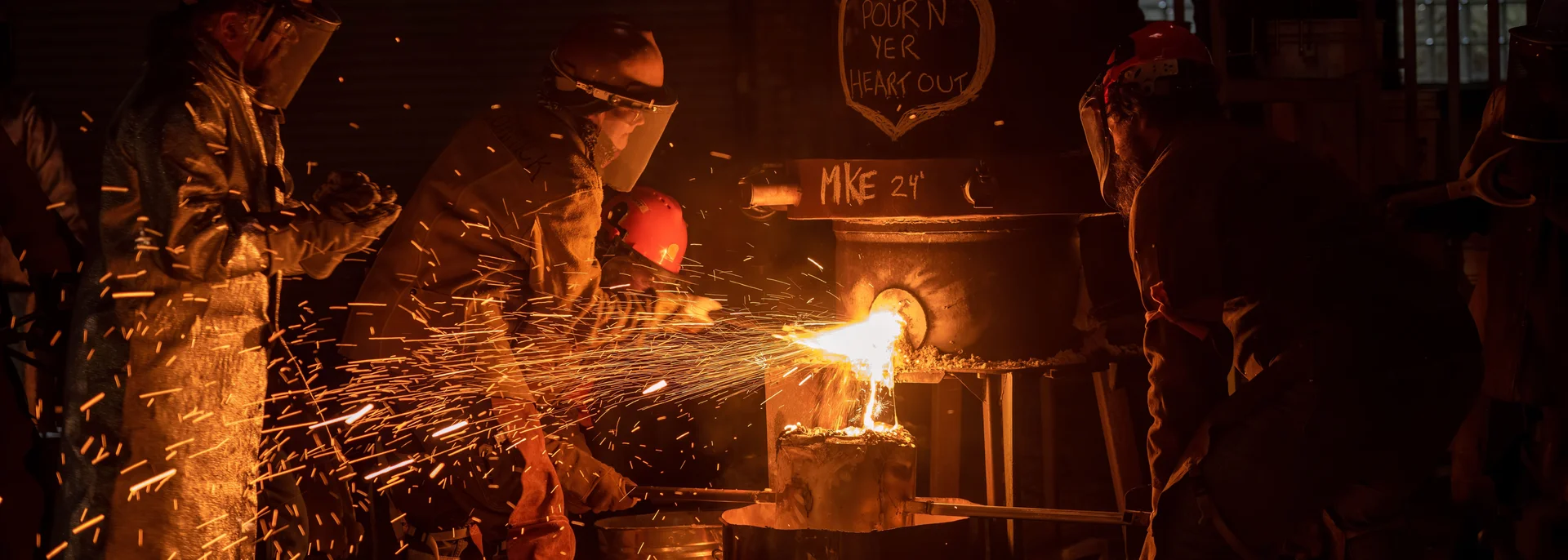
Planning to reuse spent foundry sand in Minnesota? This guide covers the rules that apply, the tests that decide how the sand can be managed, and what MPCA needs before the sand can be reused.
Key terms
Spent foundry sand
Foundries bond silica sand into molds and cores for casting metal. The sand is reused many times in the plant. Spent foundry sand is molding and core sand that can no longer make molds or cores.
Green sand and chemically bonded sand
Green sand is bonded with clay, usually bentonite, plus water and additives such as carbon. Chemically bonded sand uses resin binders. Most cores are chemically bonded. The binder system affects what the spent sand contains.
Beneficial reuse
Beneficial reuse puts a waste material to productive use instead of disposing of it. In Minnesota, MPCA uses “beneficial use determinations.” Standing determinations are written into the rule. All other uses need a case-specific determination from MPCA.
TCLP
The Toxicity Characteristic Leaching Procedure (EPA Method 1311) measures how much of certain contaminants can leach from a sample. It is one part of deciding whether a waste is hazardous.
What’s in your spent sand?
Spent sand carries what the casting process added: binder residue, metal fines, and burnt core material. The alloy matters most. Sand from iron, steel, and aluminum foundries is the most commonly reused. Sand from leaded brass and bronze foundries is often regulated as hazardous waste.
Keep each stream separate. Baghouse dust, shotblast fines, cupola slag, broken cores, and core room sweepings need their own evaluation. Mixing them into spent sand can change how the whole load is managed. Track the alloys cast, the binder system, and any process changes.
Minnesota’s beneficial use rule
Minnesota’s beneficial use rule is Minn. R. 7035.2860. It has two routes: standing beneficial use determinations listed in the rule, and case-specific determinations made by MPCA.
Standing determination for foundry sand
Subpart 4, item O, gives a standing determination to foundry sand used as a feed material for the manufacture of Portland cement. The generator or end user can use the sand this way without contacting MPCA. Only the materials and uses listed in subpart 4 have standing status. Any other use of foundry sand needs a case-specific determination.
Every beneficial use, standing or case-specific, must meet the standards in subpart 2:
- the sand is not stored in anticipation of speculative future markets;
- it is characterized under Minn. R. 7035.2861;
- it is an effective substitute for an analogous material, or a necessary ingredient in a new product;
- its use does not harm human health or the environment; and
- it is not used beyond accepted engineering or commercial standards. Excess use counts as disposal.
Hazardous waste cannot receive any beneficial use determination. Until the sand is used under a determination, it stays a solid waste. Store it under Minn. R. 7035.2855 until then.
Case-specific determinations
For every other use, MPCA decides case by case under subpart 5. After review, MPCA may ask for more information, approve the use in writing with any conditions, or deny it. After a denial, you need a permit or variance to manage the sand as proposed. MPCA may change the conditions, or revoke the determination, based on new information. MPCA posts case-specific determinations on its website.
If information needed for a determination is missing, you may propose a demonstration or research project under Minn. R. 7035.0450 to supply it.
Applying to MPCA
- Standing use: foundry sand used as Portland cement feed material under item O needs no application.
- Who files: the person proposing the use. The rule calls this person the proposer.
- How: submit through MPCA Online Services, in the solid waste permitting and approvals service. Upload attachments there. Include MPCA’s case-specific beneficial use determination checklist (w-sw7-31) and the Application for Utilization Project (w-sw7-25). Any blank entry on the checklist makes the application incomplete.
- What to include: the sand, how it is generated, the quantity generated and to be used, and the end use. Add the characterization, a health and environmental impact evaluation compared with other options, and proof the end product meets industry standards.
- Also include: a routine sampling and analysis plan, proof of a market, distribution and storage plans, and any wastes the use will create.
- Local notice: show that local governments with authority over the use received a copy of the application. Propose how to notify interested or affected parties.
- After approval: report the type and quantity used in the prior calendar year to the county where the sand is generated, by January 31 each year.
MPCA: 651-296-6300 or 800-657-3864.
Hazardous waste determination
Minnesota writes its own hazardous waste rules in Minnesota Rules chapter 7045.
Minnesota adds a deadline. Evaluate a waste within 60 days of first generating it, and record the generation start date. Waste not evaluated in time must be managed as hazardous waste. Minnesota also has a state lethality characteristic, waste code MN01, in Minn. R. 7045.0131.
Under Minn. R. 7045.0214, the foundry must decide whether its spent sand is hazardous:
- Check whether the waste is excluded from the hazardous waste rules.
- Check whether it matches a listed hazardous waste.
- Check for hazardous characteristics, including toxicity. Test the waste, or apply knowledge of the materials and processes used.
Minnesota requires generators to keep determination records for at least 3 years.
TCLP testing and limits
Tell the lab the alloys cast, the binder system, and which streams the sample includes. Use representative samples. Agree on the sampling plan with the lab, MPCA, and the receiving site before collecting.
A waste is hazardous for toxicity if its TCLP extract meets or exceeds any limit in 40 CFR 261.24. The limits for the RCRA metals are:
| Contaminant | EPA waste code | Limit (mg/L) |
|---|---|---|
| Arsenic | D004 | 5.0 |
| Barium | D005 | 100.0 |
| Cadmium | D006 | 1.0 |
| Chromium | D007 | 5.0 |
| Lead | D008 | 5.0 |
| Mercury | D009 | 0.2 |
| Selenium | D010 | 1.0 |
| Silver | D011 | 5.0 |
Passing TCLP addresses toxicity for the substances tested. It does not approve reuse or rule out other reasons a waste may be hazardous. See material testing for sampling basics.
Minn. R. 7035.2861 starts with the hazardous waste evaluation. Then list likely constituents from the process and safety data sheets, and analyze them by EPA SW-846 methods. Most cases need total analysis, and some also need leaching tests.
Finding a reuse destination
EPA’s 2014 risk assessment found three uses protective of health and the environment for silica-based spent sand from iron, steel, and aluminum foundries: manufactured soil, soil-less potting media, and road subbase. EPA and USDA support those uses. The finding does not cover sand from brass or bronze foundries, olivine sand, or sand mixed with other foundry wastes such as baghouse dust or cupola slag. EPA defers to state programs, so the state rules on this page still decide each use.
Minnesota’s standing determination for foundry sand covers one use: feed material for Portland cement manufacture. Any other destination needs a case-specific determination. Check any other destination and proposed use with MPCA before scheduling delivery.
When you talk to MPCA, describe the proposal using the standards in Minn. R. 7035.2860. For example, is the sand a substitute for an analogous material, or a necessary ingredient in a new product? Get the receiving site’s specifications and written acceptance. If reuse is not cleared, arrange disposal that fits the waste determination.
Worker protection
- Silica: foundry sand is mostly crystalline silica. OSHA’s general industry standard, 29 CFR 1910.1053, sets a permissible exposure limit of 50 µg/m³ of respirable crystalline silica as an 8-hour average. Exposure assessment starts at the 25 µg/m³ action level.
- Construction use: crews placing sand as fill or subbase fall under the construction silica standard, 29 CFR 1926.1153.
- Lead: brass and bronze foundries that cast leaded alloys also follow OSHA’s lead standard, 29 CFR 1910.1025.
- Dust: control dust during shakeout, storage, and loading.
Minnesota OSHA (MNOSHA) runs Minnesota’s OSHA-approved State Plan. For most employers, its standards apply in place of federal OSHA and must be at least as effective.
Storage and records
Store spent sand on a defined pad or in bins, control dust and runoff, and keep other foundry wastes out. Storage before beneficial use must meet Minn. R. 7035.2855, subpart 7:
- Get a Minnesota-licensed engineer’s certification that the storage facility meets the rule before operating it.
- Evaluate possible contaminant migration first. Design and run the site to prevent it, and control stormwater run-on and runoff.
- Store only the amount needed for the planned projects, and keep records proving it.
- Do not keep sand at one location for more than three years without processing or using it.
- Cover or otherwise manage sand that could blow, and control nuisance conditions.
Keep the waste determination, lab reports, MPCA determinations, and the receiving site’s acceptance together. Record tonnage shipped, dates, and destinations.
Before pickup
- Identify the alloys cast, sand and binder systems, separate streams, monthly volume, and plant location.
- Make the hazardous waste determination within 60 days and complete the required tests.
- Choose a destination and get its material specifications.
- Confirm the use is Portland cement feed under the standing determination, or file or confirm an MPCA case-specific determination.
- Get written acceptance and arrange pickup.
Common questions
Is a passing TCLP test enough?
No. It answers a toxicity question for the substances tested. The full waste determination, the beneficial use standards or MPCA determination, and the receiving site’s specifications still apply.
Does EPA’s risk assessment approve our sand?
No. It supports three soil-related uses for silica-based sand from iron, steel, and aluminum foundries. MPCA still decides each use in Minnesota.
Do we need MPCA approval to send sand to a cement plant?
No, when the sand is a feed material for Portland cement manufacture. That use has a standing determination. The sand must still meet the subpart 2 standards and the storage rule.
Does the standing determination cover concrete, fill, or soil blends?
No. Item O covers only feed material for Portland cement manufacture. Every other use needs a case-specific determination.
Can hazardous foundry sand get a determination?
No. Under Minn. R. 7035.2861, no beneficial use determination applies to hazardous waste.
How long can spent sand be stored?
No more than three years at one location without being processed or used. Stored amounts must stay reasonable for the planned projects.
When do we need to test again?
For a case-specific determination, follow the routine sampling and analysis plan in your application. It sets the procedure, frequency, and parameters. Ask MPCA about retesting when the alloy, binder, or process changes.
Rules and guidance
- MPCA: Beneficial use of solid waste
- Minn. R. 7035.2860: Beneficial use of solid waste
- Minn. R. 7035.2861: Characterizing solid wastes for beneficial use
- Minn. R. 7035.2855: Solid waste storage standards
- MPCA: Online Services, Solid Waste Permitting & Approvals Guide (w-sw7-67)
- Minnesota Rules chapter 7045: Hazardous waste
- 40 CFR 262.11: Hazardous waste determination
- 40 CFR 261.24: Toxicity characteristic
- EPA Method 1311: TCLP
- EPA: Beneficial Uses of Spent Foundry Sands
- EPA: Risk Assessment of Spent Foundry Sands in Soil-Related Applications
- 29 CFR 1910.1053: Respirable crystalline silica
- 29 CFR 1926.1153: Respirable crystalline silica in construction
- Minnesota OSHA (MNOSHA)